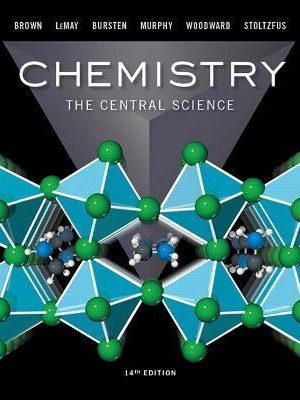
Chemistry: The Central Science 14th Edition

$7.00

Format

PDF

Author(s)

,

,

,

Publisher

ISBN-10

0134414233

ISBN-13

978-0134414232

Pages

1244

Language

English

Edition

14th edition | January 4, 2017

File Size

53 MB

Amazon Price

$80

Purchase Bonus: Get 10% credit added to your wallet after this purchase.

6 People watching this Book now!
Description

Chemistry: The Central Science 14th Edition

Chemistry: The Central Science 14th Edition (Mastering Chemistry):

Accurate, data-driven authorship with expanded interactivity leads to greater student engagement

Unrivaled problem sets, notable scientific accuracy and currency, and remarkable clarity have made Chemistry: The Central Science the leading general chemistry text for more than a decade. Trusted, innovative, and calibrated, the text increases conceptual understanding and leads to greater student success in general chemistry by building on the expertise of the dynamic author team of leading researchers and award-winning teachers.

In this new edition, the author team draws on the wealth of student data in Mastering™ Chemistry to identify where students struggle and strives to perfect the clarity and effectiveness of the text, the art, and the exercises while addressing student misconceptions and encouraging thinking about the practical, real-world use of chemistry.  New levels of student interactivity and engagement are made possible through the enhanced eText 2.0 and Mastering Chemistry, providing seamlessly integrated videos and personalized learning throughout the course .


Additional ISBNs:

∗ eText ISBN: 0134554566, 978-0134554563, 9780134554563

Table of Contents

1. Introduction: Matter, Energy, and Measurement

2. Atoms, Molecules, and Ions

3. Chemical Reactions and Reaction Stoichiometry

4. Reactions in Aqueous Solution

5. Thermochemistry

6. Electronic Structure of Atoms

7. Periodic Properties of the Elements

8. Basic Concepts of Chemical Bonding

9. Molecular Geometry and Bonding Theories

10. Gases

11. Liquids and Intermolecular Forces

12. Solids and Modern Materials

13. Properties of Solutions

14. Chemical Kinetics

15. Chemical Equilibrium

16. Acid-Base Equilibria

17. Additional Aspects of Aqueous Equilibria

18. Chemistry of the Environment

19. Chemical Thermodynamics

20. Electrochemistry

21. Nuclear Chemistry

22. Chemistry of the Nonmetals

23. Transition Metals and Coordination Chemistry

24. The Chemistry of Life: Organic and Biological Chemistry


Appendices

Mathematical Operations

Properties of Water

Thermodynamic Quantities for Selected Substances at 298.15 K (25 C)

Aqueous Equilibrium Constants

Standard Reduction Potentials at 25 C

Answers to Selected Exercises

Answers to Give It Some Thought

Answers to Go Figure

Answer to Selected Practice Exercises

Glossary

Photo and Art Credits

Theodore Brown, H. LeMay, Bruce Bursten, Catherine Murphy, Patrick Woodward, Matthew Stoltzfus

THEODORE L. BROWN received his Ph.D. from Michigan State University in 1956. Since then, he has been a member of the faculty of the University of Illinois, Urbana-Champaign, where he is now Professor of Chemistry, Emeritus. He served as Vice Chancellor for Research, and Dean of The Graduate College, from 1980 to 1986, and as Founding Director of the Arnold and Mabel Beckman Institute for Advanced Science and Technology from 1987 to 1993. Professor Brown has been an Alfred P. Sloan Foundation Research Fellow and has been awarded a Guggenheim Fellowship. In 1972 he was awarded the American Chemical Society Award for Research in Inorganic Chemistry and received the American Chemical Society Award for Distinguished Service in the Advancement of Inorganic Chemistry in 1993. He has been elected a Fellow of the American Association for the Advancement of Science, the American Academy of Arts and Sciences, and the American Chemical Society.

H. EUGENE LEMAY, JR., received his B.S. degree in Chemistry from Pacific Lutheran University (Washington) and his Ph.D. in Chemistry in 1966 from the University of Illinois, Urbana-Champaign. He then joined the faculty of the University of Nevada, Reno, where he is currently Professor of Chemistry, Emeritus. He has enjoyed Visiting Professorships at the University of North Carolina at Chapel Hill, at the University College of Wales in Great Britain, and at the University of California, Los Angeles. Professor LeMay is a popular and effective teacher, who has taught thousands of students during more than 40 years of university teaching. Known for the clarity of his lectures and his sense of humor, he has received several teaching awards, including the University Distinguished Teacher of the Year Award (1991) and the first Regents’ Teaching Award given by the State of Nevada Board of Regents (1997).

BRUCE E. BURSTEN received his Ph.D. in Chemistry from the University of Wisconsin in 1978. After two years as a National Science Foundation Postdoctoral Fellow at Texas A&M University, he joined the faculty of The Ohio State University, where he rose to the rank of Distinguished University Professor. In 2005, he moved to the University of Tennessee, Knoxville, as Distinguished Professor of Chemistry and Dean of the College of Arts and Sciences. Professor Bursten has been a Camille and Henry Dreyfus Foundation Teacher-Scholar and an Alfred P. Sloan Foundation Research Fellow, and he is a Fellow of both the American Association for the Advancement of Science and the American Chemical Society. At Ohio State he has received the University Distinguished Teaching Award in 1982 and 1996, the Arts and Sciences Student Council Outstanding Teaching Award in 1984, and the University Distinguished Scholar Award in 1990. He received the Spiers Memorial Prize and Medal of the Royal Society of Chemistry in 2003, and the Morley Medal of the Cleveland Section of the American Chemical Society in 2005. He was President of the American Chemical Society for 2008. In addition to his teaching and service activities, Professor Bursten’s research program focuses on compounds of the transition-metal and actinide elements.

CATHERINE J. MURPHY received two B.S. degrees, one in Chemistry and one in Biochemistry, from the University of Illinois, Urbana-Champaign, in 1986. She received her Ph.D. in Chemistry from the University of Wisconsin in 1990. She was a National Science Foundation and National Institutes of Health Postdoctoral Fellow at the California Institute of Technology from 1990 to 1993. In 1993, she joined the faculty of the University of South Carolina, Columbia, becoming the Guy F. Lipsc

Immediately after payment, you can Download Chemistry: The Central Science 14th Edition e-Book (PDF).

Reviews

There are no reviews yet.

Be the first to review “Chemistry: The Central Science 14th Edition”

Your email address will not be published. Required fields are marked *